
Scotland’s heroes are not confined to history books. Their stories live on in poetry, music, tradition and the memories passed from one generation to the next. From warriors who fought for Scotland’s independence to poets whose words travelled far beyond its borders, each has helped shape the character of the nation.
Stirling1314’s forthcoming Heroes of Scotland collection brings six of these stories together through a series of handcrafted pewter collectible figures, each representing a different chapter in Scotland’s history and culture.
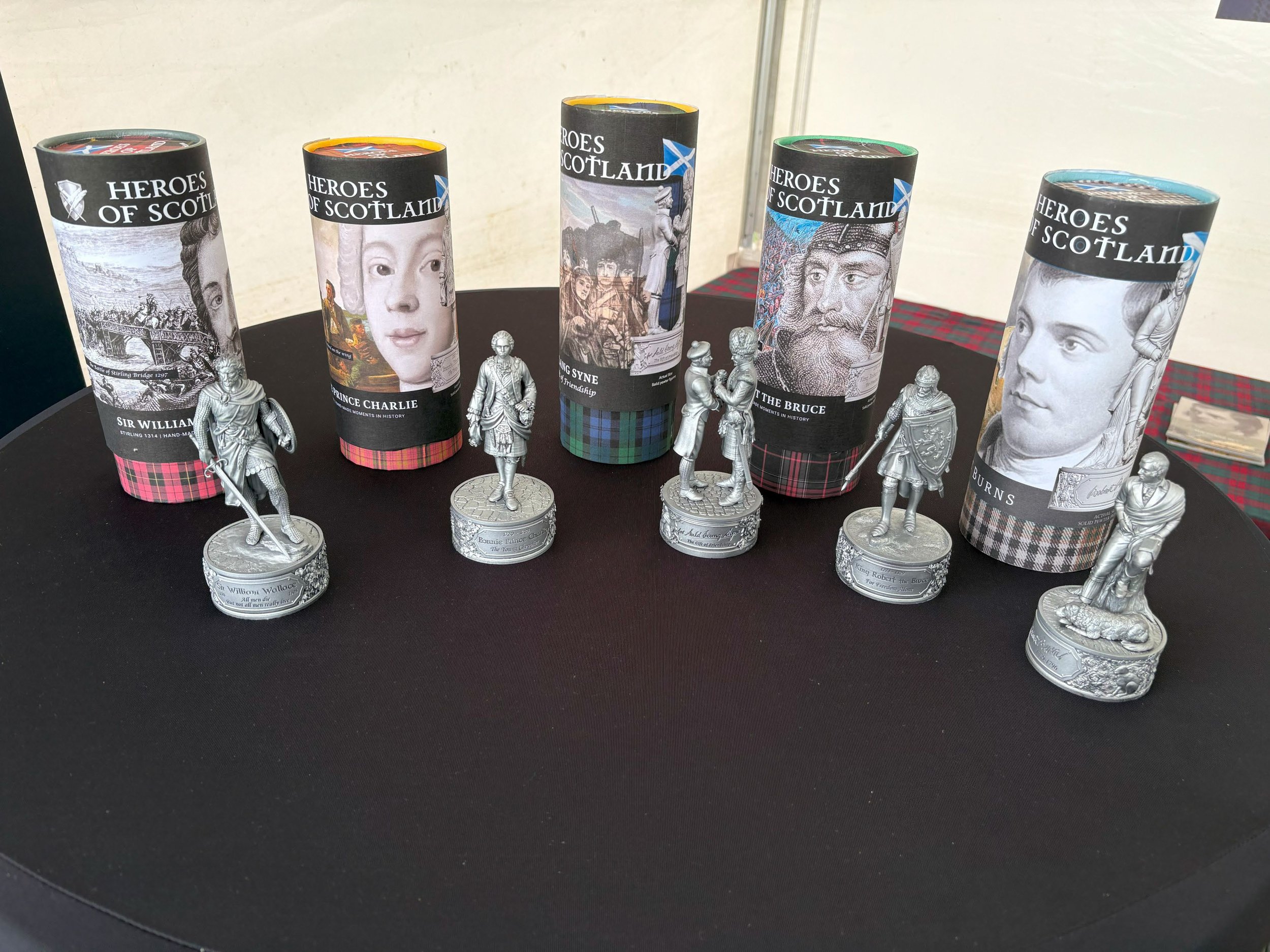
Showcasing the Heroes of Scotland collection at the World Pipe Band Championships
Robert the Bruce: Leadership and Determination
Few Scottish heroes are as closely associated with leadership and independence as Robert the Bruce. His struggle for the Scottish crown and his role in the Battle of Bannockburn have secured his place among Scotland’s most celebrated historical figures.
Yet Bruce’s story is also one of persistence. His journey was marked by setbacks, uncertainty and conflict before his decisive victory at Bannockburn in 1314. Within the Heroes of Scotland collection, his figure represents determination and leadership in the face of adversity.
Sir William Wallace: Courage and Defiance
Sir William Wallace occupies an equally powerful place in Scotland’s historical imagination. A central figure in the Wars of Scottish Independence, Wallace became a symbol of resistance against English rule.
His story has endured for centuries, becoming part of Scotland’s cultural identity as much as its history. Alongside Robert the Bruce, his inclusion in the collection reflects the struggles that shaped medieval Scotland and the individuals whose courage continues to capture the imagination.
Robert Burns: Scotland Through Poetry
Not all Scottish heroes carried a sword. Robert Burns shaped Scotland through words.
Scotland’s national poet captured the language, humour, relationships and everyday experiences of his country, transforming them into poetry that continues to be read and recited around the world. His influence reaches well beyond literature, with works such as Auld Lang Syne becoming part of international traditions.
For Stirling1314, Burns represents the cultural side of Scotland’s story: its language, creativity and ability to communicate something deeply Scottish in a way that resonates universally.
Bonnie Prince Charlie: Loyalty and Legend
Bonnie Prince Charlie brings another chapter of Scotland’s history into the collection. Charles Edward Stuart became the figurehead of the Jacobite cause, leading the 1745 uprising in an attempt to reclaim the British throne for his family.
His story has since become intertwined with romance, loyalty and loss. Whether viewed through the lens of history or legend, Bonnie Prince Charlie remains one of the most recognisable figures associated with Scotland’s past.
His inclusion acknowledges the enduring power of historical figures to become part of a nation’s collective memory.
The Scottish Piper: A Living Tradition
The Scottish Piper represents something different. Rather than depicting a single historical individual, the figure celebrates one of Scotland’s most recognisable cultural traditions.
The sound of the pipes has long been associated with ceremony, celebration and remembrance. From Highland gatherings to military occasions, piping has played an important role in Scottish life and has carried Scottish culture far beyond its borders.
Within the collection, the Piper provides a connection to living tradition, a reminder that heritage is not only found in the past, but continues through music and ritual.
Auld Lang Syne: Friendship and Memory
The final figure brings the collection back to one of Scotland’s most enduring cultural expressions: Auld Lang Syne.
Associated with Robert Burns, the song has become a worldwide expression of friendship, remembrance and shared experience. Its sentiment is simple but powerful: we may move forward, but the people and moments that shaped us remain worth remembering.
That makes the Auld Lang Syne figure a particularly distinctive part of the collection. Rather than representing a battle or a historical leader, it captures something universal, the importance of friendship, memory and human connection.
Six Figures, Centuries of Stories
The Heroes of Scotland collection has been created with longevity in mind. These are collectible figures designed to become part of a home, where they can serve as physical reminders of the stories they represent.
Each figure is cast in heavy, traditional pewter and hand-finished with attention to the details that bring the character to life. The substantial weight is intentional. These are not designed as fleeting souvenirs, but as objects that can be displayed, studied and appreciated.
Because the stories of Scotland’s heroes have never belonged solely to the past. They continue to be told, remembered and passed on, just as these figures are designed to be.
